Best VoIP providers in Chennai | Unified solution provider in Chennai

What Is SIP Trunking? How It Works, Benefits, Types, Features & Business Use Cases
Traditional business phone systems often depend on physical telephone lines, making expansion, maintenance, and multi-location communication more complicated. Modern IP-based communication offers a more flexible alternative, allowing companies to manage voice calls through their internet infrastructure.
One of the technologies behind this transition is SIP trunking.
But how does it work? What are its advantages, and is it suitable for your business?
In this guide, we’ll explain the technology, its features, different deployment options, potential costs, and practical business applications in simple terms.
What Is SIP Trunking?
SIP trunking is an internet-based communication technology that allows businesses to make and receive telephone calls through an IP network rather than relying entirely on traditional telephone lines.
SIP stands for Session Initiation Protocol. It is a communication protocol used to establish, manage, modify, and end voice and multimedia sessions over an IP network.
A virtual connection is created between a company’s phone system, such as an IP PBX or cloud-based PBX, and a telecommunications provider. This connection can carry multiple simultaneous conversations over an internet connection.
For organizations, this approach can make business calling easier to manage while providing greater flexibility as communication requirements change.
How Does It Work?
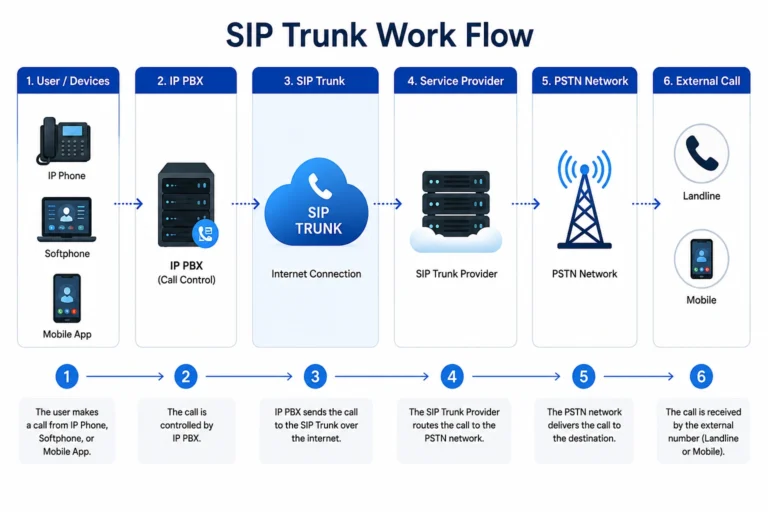
Business Phone System → Internet Connection → Service Provider → Telephone Network
When an employee makes an outbound call, the business phone system sends the session information through the internet. The communications provider receives the request and routes the call to the intended destination.
Incoming calls follow the opposite path. The provider receives the call and directs it through the IP network to the company’s phone system.
This eliminates the need to maintain a separate physical telephone connection for every employee or calling channel.
The quality of the service, however, depends heavily on factors such as internet connectivity, network performance, provider infrastructure, latency, and configuration.
Key Features
A modern business calling solution can provide several useful capabilities.
Multiple Concurrent Calls
Companies can handle several conversations simultaneously without installing an individual physical line for every user.
Flexible Capacity
Calling capacity can be adjusted as employee numbers, departments, and call volumes change.
Business Numbers
Organizations can retain eligible existing numbers or obtain new business numbers based on their requirements and provider availability.
Intelligent Call Routing
Calls can be directed to specific employees, departments, offices, or alternative destinations according to predefined rules.
IP PBX Integration
The service can connect compatible IP PBX systems to external telephone networks, allowing organizations to continue using their existing business phone infrastructure.
Advanced Call Management
Depending on the provider and phone system, businesses can access features such as IVR, call forwarding, voicemail, recording, queues, analytics, and call routing.
Benefits for Modern Businesses
Moving from conventional telephone infrastructure to an IP-based setup can provide several advantages.
1. Potentially Lower Communication Costs
Traditional systems can involve separate line rentals, maintenance expenses, and infrastructure costs. Consolidating voice communication over an existing internet connection may reduce some of these expenses.
2. Easier Expansion
Adding employees or opening another office shouldn’t require extensive telephone infrastructure. Additional calling capacity can generally be provisioned more easily through an IP-based system.
3. Multi-Location Connectivity
Organizations operating from multiple offices can connect their communication infrastructure across locations. This can create a more consistent calling environment for employees and customers.
4. Greater Business Continuity
With appropriate routing and failover configurations, calls can potentially be redirected to another location, number, or device when a particular office or system becomes unavailable.
5. Support for Remote Teams
Employees increasingly work from different locations. IP-based communication can support compatible phones, applications, and business communication platforms, helping distributed teams stay connected.
6. Access to Advanced Features
Businesses can combine their voice infrastructure with modern PBX capabilities such as IVR, call queues, recording, analytics, voicemail, and automated routing.
Types of Deployment
There isn’t a single deployment model that works for every organization. The right approach depends on existing infrastructure, technical resources, and business requirements.
On-Premises Deployment
Here, the organization maintains its own IP PBX or communication server. The service provider connects this system to the external telephone network.
This provides greater control over the internal infrastructure but may require more technical expertise, maintenance, and hardware investment.
Cloud-Based Deployment
With a cloud-based model, more of the communication infrastructure is managed by the service provider.
This can reduce the amount of equipment businesses need to maintain themselves and may be particularly useful for organizations that want a more flexible communication environment.
Hybrid Deployment
Some companies combine on-premises equipment with cloud communication services. A hybrid approach can be useful when an organization is gradually moving away from legacy telephone infrastructure.
SIP Trunking vs VoIP: What's the Difference?
These two terms are often used interchangeably, but they don’t mean exactly the same thing.
VoIP, or Voice over Internet Protocol, is the broader technology used to transmit voice communication over IP networks.
SIP is a protocol that can be used to establish and manage those communication sessions.
The trunking service provides the connection that allows a business phone system to communicate with the external telephone network over an IP connection.
In simple terms:
VoIP: Voice communication over an IP network
SIP: Protocol used to establish and manage communication sessions
SIP trunk: A virtual connection between a business phone system and a telephone network
Understanding this difference can help businesses evaluate communication solutions more accurately.
What Affects the Cost?
Pricing varies significantly between providers and business requirements. Several factors can influence the overall cost:
- Number of concurrent calls
- Number of business telephone numbers
- Local and international calling requirements
- Existing PBX equipment
- Internet connectivity
- Additional communication features
- Installation or setup requirements
- Technical support and service plans
Businesses shouldn’t compare providers based only on monthly pricing. Network reliability, call quality, scalability, security, support, and feature availability are equally important.
Business Use Cases
This technology can support organizations with different communication requirements.
Call Centers
Contact centers can use multiple calling channels to manage high volumes of inbound and outbound conversations.
Multi-Branch Organizations
Companies with offices in different cities can connect their communication infrastructure through IP-based services.
Sales Teams
Sales departments can benefit from scalable outbound calling while integrating their voice infrastructure with broader business communication tools.
Customer Support
Support teams can combine voice communication with IVR, queues, recording, and analytics to create a more organized customer service process.
Growing Companies
Businesses experiencing rapid growth can increase calling capacity as their workforce and communication requirements expand.
How to Choose the Right Provider
Selecting a suitable SIP trunk provider requires looking beyond price.
Network Reliability
Check the provider’s infrastructure, uptime commitments, and network design.
Voice Quality
Ask about latency, jitter, packet loss, and the measures used to maintain clear conversations.
Scalability
Make sure the service can accommodate additional users, numbers, and concurrent calls as your business grows.
Security
Consider protection against toll fraud, unauthorized access, and other communication-related threats.
Technical Support
Reliable support is essential when voice communication is critical to daily operations.
Compatibility
Confirm that the service works with your existing IP PBX, cloud PBX, phones, and other communication systems.
Is This Technology Right for Your Business?
An IP-based telephone connection can be a practical choice for businesses that want to modernize their communication infrastructure, support multiple locations, accommodate remote teams, or increase calling capacity without relying entirely on traditional telephone lines.
However, the right solution depends on your existing phone system, internet connection, call volume, number requirements, budget, and future growth plans.
Before making a decision, assess your current infrastructure and identify the communication features your teams actually need.
Conclusion
SIP trunking provides businesses with a modern way to connect their phone systems to the telephone network through IP infrastructure. Compared with traditional telephone connections, it can offer greater flexibility, easier scalability, and access to advanced business calling capabilities.
From contact centers and sales teams to multi-location companies and growing organizations, this technology can support a wide range of communication requirements.
If you’re planning to modernize your business phone infrastructure, choosing the right provider and ensuring reliable network connectivity are essential steps toward building a scalable communication environment.
Looking for a business-ready voice communication solution? Contact Skyfall Voice to discuss your calling requirements and explore the right setup for your organization.
Frequently Asked Questions
What is SIP trunking in simple terms?
It is an internet-based telephone connection that allows a business phone system to make and receive calls through an IP network instead of relying entirely on traditional telephone lines.
Is SIP trunking the same as VoIP?
No. VoIP refers broadly to voice communication over IP networks. SIP is a protocol used to manage communication sessions, while a SIP trunk provides a virtual connection between a business phone system and the telephone network.
What are the main benefits?
Key advantages include flexible capacity, easier expansion, multi-location connectivity, potential infrastructure savings, support for remote teams, and access to advanced calling features.
Can it work with an IP PBX?
Yes. It is commonly used to connect compatible IP PBX systems with external telephone networks.
How much does it cost?
Pricing depends on factors such as concurrent call capacity, telephone numbers, destinations, features, infrastructure, and provider plans. Businesses should evaluate the complete service rather than monthly pricing alone.
Is it suitable for small businesses?
Yes. Small and growing companies can use IP-based telephone services to obtain scalable business calling capabilities without building extensive traditional telephone infrastructure.