Best VoIP providers in Chennai | Unified solution provider in Chennai

How AI-Powered VoIP Is Changing Revenue Cycle Management in 2026
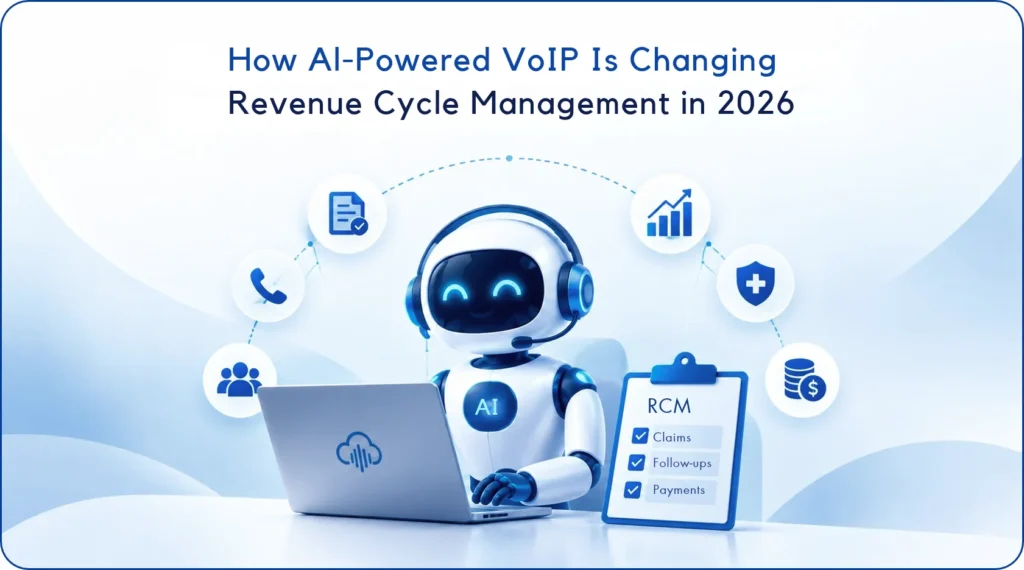
Revenue cycle management (RCM) depends on efficient communication. Billing teams, healthcare providers, insurance companies, patients, and other stakeholders often need to communicate quickly to resolve eligibility questions, follow up on claims, verify information, and address payment-related issues. As RCM operations become more complex, AI-powered VoIP for RCM is emerging as a technology approach that can help organizations manage high-volume communication more efficiently.
Traditional business phone systems can make it difficult for growing RCM teams to manage large call volumes, distribute calls intelligently, track conversations, and understand team performance. AI-powered VoIP combines cloud-based business calling with automation, intelligent routing, analytics, and AI-enabled capabilities to create a more connected communication environment.
In 2026, the broader use of AI across healthcare revenue cycle operations is gaining momentum. Industry research reports increasing adoption of AI-enabled RCM tools, although organizations continue to consider privacy, security, accuracy, cost, and human oversight when implementing these technologies.
What Is AI-Powered VoIP for RCM?
AI-powered VoIP for RCM combines Voice over Internet Protocol (VoIP) communication with artificial intelligence and cloud-based calling features.
Instead of relying on a traditional phone system where employees manually handle every call, an AI-enabled communication platform can support teams with functions such as:
- Intelligent call routing
- Automated call handling
- IVR and virtual receptionists
- Call queues
- Call recording
- Call analytics
- AI-assisted conversations
- Call summaries
- Real-time dashboards
- Agent performance monitoring
- CRM and business software integrations
For RCM organizations, these capabilities can be particularly useful when employees handle large numbers of payer, provider, patient, or internal calls.
The goal is not necessarily to replace RCM professionals. Instead, AI-powered communication can help employees spend less time managing repetitive communication tasks and more time handling activities that require human judgment.
Why RCM Teams Need Smarter Communication
Revenue cycle operations involve multiple stages, from patient access and eligibility verification through claims processing, follow-up, payment posting, and denial management.
Communication can become a bottleneck when teams are dealing with:
- High outbound call volumes
- Long call queues
- Repetitive payer conversations
- Multiple departments
- Distributed employees
- Manual call tracking
- Difficult-to-measure team performance
- Missed or unanswered calls
- Time-consuming follow-ups
A traditional phone system may provide basic calling functionality, but modern RCM operations often require more visibility and flexibility.
Cloud VoIP allows organizations to centralize communication while giving managers greater visibility into call activity and team performance.
How AI-Powered VoIP Is Changing RCM Communication
1. Intelligent Call Routing
Large RCM teams may have separate employees or departments handling different responsibilities.
For example, calls may need to be directed toward teams responsible for:
- Eligibility verification
- Claims follow-up
- Denial management
- Accounts receivable
- Patient billing
- Insurance verification
- Provider communication
AI-assisted routing can help direct calls according to predefined rules, caller information, department, availability, or other business conditions.
This can reduce unnecessary transfers and help employees receive calls relevant to their responsibilities.
2. Automation for Repetitive Calls
Many RCM operations involve repetitive communication.
Teams may need to make similar calls repeatedly to confirm information, follow up on processes, or obtain updates.
AI voice technology can potentially support selected repetitive interactions, depending on the workflow and organization’s compliance requirements.
For example, an automated voice system could handle an initial interaction before routing more complex requests to a human representative.
This creates an opportunity to automate parts of the communication workflow without removing human involvement where it is necessary.
3. Better Call Management for High-Volume Teams
High call volumes can become challenging when teams rely on individual phone numbers or disconnected calling systems.
Cloud VoIP can provide centralized call queues, extensions, call distribution, and department-based routing.
For an RCM organization handling hundreds or thousands of calls, this type of architecture can make communication easier to organize.
Managers can also gain visibility into metrics such as call volumes, answered calls, missed calls, waiting times, and agent activity, depending on the platform.
4. AI-Assisted Call Summaries
Call documentation can consume significant employee time.
AI-enabled systems may be able to generate summaries from eligible conversations, helping employees review key points without manually documenting every detail.
For RCM teams, this could be useful when a representative needs to record information from a payer or other business conversation.
However, organizations should establish appropriate policies around recording, transcription, retention, access, and handling of sensitive information.
5. Real-Time Call Analytic
Data can help RCM managers understand how communication operations are performing.
Modern VoIP platforms can provide dashboards containing information such as:
- Total calls
- Answered calls
- Missed calls
- Call duration
- Agent activity
- Department performance
- Call trends
- Peak calling periods
These insights can help managers identify communication bottlenecks and make better operational decisions.
The value comes from using analytics to improve processes—not simply collecting more data.
AI Voice Bots and Revenue Cycle Management
AI voice bots are another emerging area of interest for RCM organizations.
A voice bot can interact with callers using conversational AI and predefined business workflows. Depending on the use case, it may answer basic questions, collect information, identify the purpose of a call, or transfer the conversation to an appropriate employee.
For RCM companies, potential applications could include:
Initial call qualification:
Identify why a caller is contacting the organization before transferring the call.
Routine information collection:
Collect predefined information during appropriate workflows.
Call routing:
Direct callers to the relevant RCM department.
After-hours assistance:
Provide automated responses when employees are unavailable.
Appointment or callback workflows:
Support selected scheduling or callback processes where appropriate.
The exact capabilities depend on the technology, workflow, data involved, and compliance requirements.
How VoIP Can Support Distributed RCM Teams
Many RCM operations involve employees working across different offices or locations.
Traditional phone infrastructure can make remote communication more complicated because employees may depend on physical office phones or location-specific systems.
Cloud VoIP provides a different model.
Authorized employees can use business calling applications from supported devices and locations, while administrators can manage users, extensions, routing, and communication policies centrally.
This can be useful for RCM companies operating across multiple locations or using distributed teams.
Security and Compliance Should Come First
Healthcare-related communication requires careful consideration of privacy and security.
Organizations handling protected health information (PHI) should evaluate how their communication provider processes, stores, transmits, and protects information.
The U.S. Department of Health and Human Services explains that a cloud service provider that creates, receives, maintains, or transmits electronic protected health information on behalf of a covered entity or business associate can fall under HIPAA’s business associate requirements. A HIPAA-compliant Business Associate Agreement (BAA) may therefore be required depending on the relationship and services involved.
HHS also notes that organizations using cloud services for ePHI should understand the cloud environment, conduct appropriate risk analysis, and establish suitable risk-management practices.
Therefore, RCM companies should evaluate a VoIP or AI communication provider based on factors such as:
- Data protection
- Access controls
- Encryption
- Call recording policies
- Data retention
- Audit capabilities
- Vendor agreements
- HIPAA requirements where applicable
- Integration security
- Business continuity
Technology alone does not make a communication system compliant. Organizations need appropriate processes, contracts, configurations, and safeguards.
What RCM Companies Should Look for in AI-Powered VoIP
Before choosing a platform, RCM organizations should consider whether it supports their actual communication requirements.
Important features may include:
Scalable cloud calling:
Support growing teams and changing call volumes.
Intelligent call routing:
Send calls to the appropriate employee or department.
IVR and call queues:
Organize incoming communication efficiently.
Call analytics:
Provide useful information about communication performance.
AI capabilities:
Support appropriate automation and assistance workflows.
CRM integration:
Connect communication activity with existing business systems where supported.
Security controls:
Protect sensitive business and healthcare-related information.
Administrative controls:
Allow managers to manage users, extensions, permissions, and routing.
Reliable connectivity:
Provide stable communication for teams handling business-critical calls.
The Future of AI-Powered VoIP in RCM
The future of RCM communication is likely to involve greater integration between voice technology, automation, analytics, and existing healthcare business systems.
AI is already moving beyond experimental use in parts of revenue cycle management. Current 2026 industry research points toward broader adoption while emphasizing the importance of human oversight and responsible implementation.
For communication specifically, the next generation of VoIP platforms may increasingly combine:
Cloud calling + AI voice automation + intelligent routing + analytics + business integrations
This combination can give RCM organizations a more connected communication infrastructure while allowing human employees to focus on conversations and decisions that require greater judgment.
Conclusion
AI-powered VoIP for RCM represents an evolution from basic business calling to intelligent communication infrastructure.
For revenue cycle management companies dealing with high call volumes, distributed teams, repetitive conversations, and the need for better visibility, AI-enabled VoIP can support more organized and efficient communication workflows. Skyfall Voice provides business communication solutions that can help RCM teams build a more connected and scalable calling environment.
The most effective approach is not simply to add AI to every calling process. RCM organizations should identify specific communication challenges, determine where automation provides genuine value, and implement technology with appropriate security, privacy, compliance, and human oversight.
As RCM continues to become more technology-driven in 2026, intelligent communication solutions from providers such as Skyfall Voice can play a valuable role in supporting scalable and efficient revenue cycle operations.