Best VoIP providers in Chennai | Unified solution provider in Chennai

Internet Leased Line, SD-WAN & SASE: A Practical Guide to Modern Business Connectivity
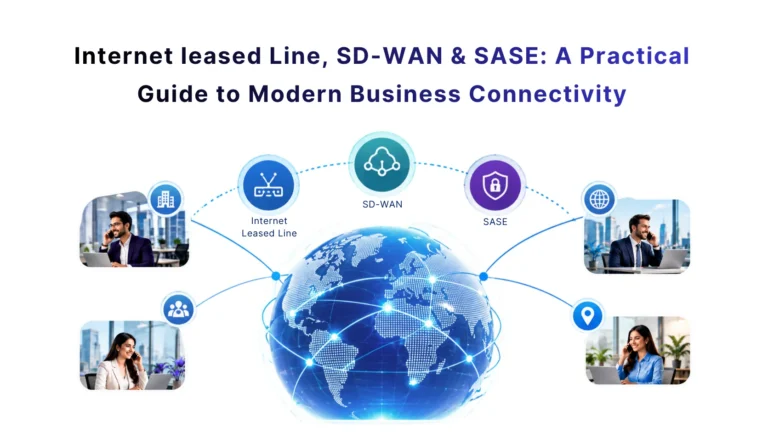
Business connectivity is no longer simply about having a fast internet connection. Modern organizations depend on cloud applications, video conferencing, VoIP, SaaS platforms, AI tools, and real-time data exchange to operate every day.
As businesses become more distributed and digitally connected, traditional network designs are also evolving. Three technologies are becoming increasingly important in this transformation: Internet Leased Lines, SD-WAN, and SASE.
Each addresses a different networking challenge. A dedicated connection provides predictable internet access, SD-WAN helps manage traffic intelligently across multiple connections, and SASE combines networking with cloud-based security.
For businesses planning their next stage of digital growth, understanding how these technologies work together can help create a network that is reliable, flexible, and ready for changing demands.
What Is Changing in Enterprise Connectivity?
A few years ago, many organizations operated primarily from a central office. Most applications and data were hosted within company premises, so networks were designed mainly around connecting employees to an internal data center.
Today, the environment is very different.
Employees may work from offices, homes, branch locations, or while travelling. Business applications are increasingly hosted in the cloud. Customer interactions happen through digital channels, while voice and video communication require consistent network performance.
This creates a new requirement: businesses need connectivity that is not only fast but also stable, secure, scalable, and intelligent.
This is where Internet Leased Lines, SD-WAN, and SASE can work together.
Internet Leased Line: The Foundation of Reliable Business Connectivity
An Internet Leased Line is a dedicated internet connection designed for business use. It can provide more predictable performance than a typical shared internet connection, making it suitable for organizations that rely heavily on online applications.
Consider a company using cloud-based CRM software, VoIP calling, Microsoft 365, video meetings, cloud storage, and other business applications simultaneously. Network instability can affect several operations at once.
A dedicated business connection can support:
Consistent network performance
Dedicated bandwidth
Cloud and SaaS applications
Voice and video communication
Symmetrical upload and download capabilities, depending on the service
Static IP requirements
Business-focused connectivity and support
Skyfall Voice provides enterprise connectivity solutions designed around business requirements, including Internet Leased Line services for organizations that depend on reliable internet access for their day-to-day operations.
However, simply increasing bandwidth does not solve every networking challenge. When an organization has multiple offices, cloud environments, and different types of connections, traffic management becomes more complicated.
That is where SD-WAN comes in.
What Is SD-WAN?
SD-WAN, or Software-Defined Wide Area Networking, is a networking approach that uses software-based intelligence to manage traffic across different connections.
Instead of depending entirely on traditional hardware-based routing, SD-WAN can evaluate network conditions and apply predefined policies to different types of traffic.
For example, a business could have:
Internet Leased Line
Broadband
4G/5G connectivity
Private network connections
SD-WAN can help organizations manage these connections through centralized policies.
Critical applications such as VoIP, video conferencing, ERP, and cloud applications can be given appropriate priority, while less important traffic can be handled differently.
This becomes particularly useful for organizations operating multiple branches.
How SD-WAN Complements a Leased Line
It is not necessarily a question of choosing between an Internet Leased Line and SD-WAN. They solve different parts of the networking challenge.
The leased line can provide a reliable connectivity foundation, while SD-WAN can help intelligently manage traffic across available network resources.
For example, a company with offices in Chennai, Bangalore, Mumbai, and Hyderabad could use dedicated connectivity at key locations while maintaining additional connections for redundancy or supplementary capacity.
SD-WAN can then help manage traffic between branches, cloud services, and data centers.
For businesses expanding across multiple locations, this combination can make network management more flexible.
What Is SASE?
SASE stands for Secure Access Service Edge.
While SD-WAN primarily addresses connectivity and traffic management, SASE brings networking and security capabilities together through a cloud-oriented architecture.
Traditional security models often assume that employees and applications are located inside a company’s physical network.
Modern organizations are much more distributed.
Employees may access applications from home. Branch offices may connect directly to cloud platforms. Contractors and partners may require controlled access to business resources.
SASE is designed for this changing environment.
Depending on the implementation, a SASE architecture can include:
Secure web access
Zero Trust Network Access
Firewall-as-a-Service
Cloud-based security controls
Secure application access
Data protection
SD-WAN capabilities
Rather than treating networking and security as completely separate systems, SASE brings them closer together.
SD-WAN vs SASE: What's the Difference?
The two technologies are related, but they are not the same.
SD-WAN primarily addresses connectivity and traffic management.
It helps organizations determine how network traffic should travel across different connections and locations.
SASE combines networking with security.
It extends the networking model by applying security controls closer to users, devices, applications, and cloud resources.
A simple way to understand the relationship is:
Internet Leased Line → Reliable Connectivity
SD-WAN → Intelligent Traffic Management
SASE → Connectivity + Cloud-Based Security
Together, these technologies can form an important part of a modern enterprise networking strategy.
Why Businesses Are Moving Toward This Model
The biggest change is not simply technological. It is the way businesses operate.
Cloud adoption, remote work, branch expansion, SaaS applications, AI tools, and digital customer experiences are creating more complex connectivity requirements.
Businesses therefore need to consider more than download speed when designing their networks.
Important factors include:
1. Reliability
Critical business applications need consistent connectivity. Network interruptions can affect employees, customers, and business operations.
2. Security
More users and applications are operating outside traditional office networks. Security therefore needs to extend beyond the physical workplace.
3. Flexibility
Organizations need to add branches, users, cloud applications, and new connectivity options without completely redesigning their network.
4. Traffic Control
Not every application has the same priority. Voice calls and video meetings may require different treatment from routine downloads.
5. Scalability
The network should grow alongside the business without becoming unnecessarily complex.
Building a Future-Ready Enterprise Network
There is no single architecture that fits every organization.
A small company with one office may only require reliable dedicated connectivity and appropriate security controls. A growing enterprise with several branches, remote employees, and cloud applications may benefit from combining dedicated connectivity with SD-WAN and SASE capabilities.
This is where choosing the right connectivity partner becomes important.
Skyfall Voice helps businesses explore enterprise communication and connectivity solutions based on their operational requirements, whether the need involves dedicated internet connectivity, cloud communication, VoIP, or other business networking services.
The objective should not simply be to purchase more bandwidth. Instead, businesses should build an infrastructure that supports their applications, employees, customers, security requirements, and future expansion.
Conclusion
Enterprise connectivity is moving from a simple “faster internet” approach toward a more intelligent combination of connectivity, traffic management, and security.
An Internet Leased Line can provide a stable connectivity foundation. SD-WAN can make network traffic more adaptable and manageable across multiple connections. SASE can extend security into a cloud-first and distributed business environment.
These technologies are not necessarily replacements for one another. When appropriately designed, they can work together to create a more resilient and flexible network architecture.
For businesses preparing for continued cloud adoption, distributed workforces, AI applications, and digital expansion, understanding these technologies is an important part of planning the next generation of enterprise connectivity.
Skyfall Voice — Building smarter, more connected business communication for the digital enterprise.